
British Columbia and Yukon share amateur radio frequency coordination through the BC Amateur Radio Coordination Council (BCARCC), which has managed repeater frequencies since January 1995. In November 1996, BCARCC signed a Memorandum of Understanding with ISED (then Industry Canada) establishing its advisory role for frequency coordination in the region.
This page provides a BC frequency list covering VHF frequencies BC and Yukon operators use for repeaters, simplex, and emergency communications.
1995
Year BCARCC was incorporated
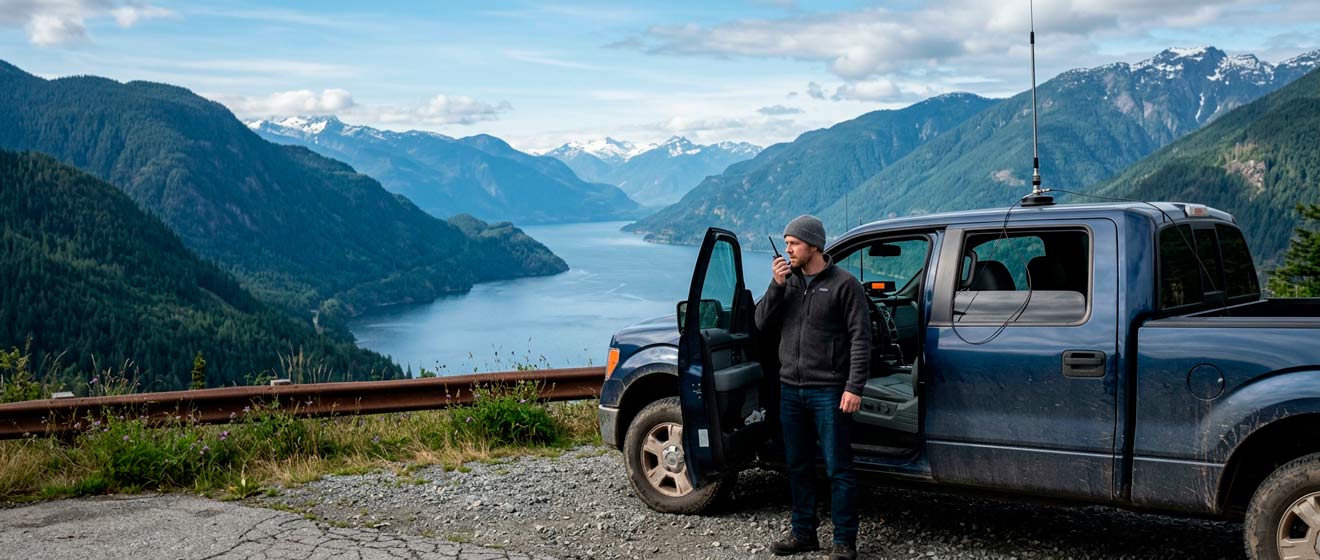
VHF Band Plan for British Columbia
The 2-meter band (144–148 MHz) is the most active VHF allocation in BC. For operators looking up VHF frequencies in BC, BCARCC adapts the RAC national band plan and coordinates with the Western Washington Amateur Relay Association (WWARA) across the border. The standard repeater offset is ±600 kHz.
Frequency | Mode | Usage |
|---|---|---|
144.000–144.100 | CW only | CW, EME |
144.100–144.275 | CW/SSB | Weak signal, DX |
144.200 | SSB/CW | National calling frequency |
144.390 | APRS | Packet/APRS |
145.010–145.490 | FM | Repeater inputs (–600 kHz offset) |
145.610–146.090 | FM | Repeater outputs (+600 kHz offset) |
146.520 | FM Simplex | National simplex calling frequency |
146.400 | FM Simplex | BC preferred simplex |
147.000–147.390 | FM | Repeater outputs (+600 kHz offset) |
Simplex note: 146.520 MHz is the national FM simplex calling frequency. In BC, 146.400 MHz is preferred as an alternative simplex channel and may be coordinated as an alternative repeater input for 147.000 MHz outputs in some areas.
UHF Frequencies & Repeaters
The 70-centimeter band (430–450 MHz) provides secondary amateur allocations in Canada – radiolocation is primary. The standard repeater offset is –5 MHz (outputs on 442–445 MHz, inputs on 447–450 MHz). Amateur satellite operations share portions of this band on a non-interference basis.
Frequency | Mode | Usage |
|---|---|---|
430.000–432.000 | Mixed | Weak signal, satellites (secondary) |
432.100 | SSB/CW | Weak signal calling frequency |
433.000–434.000 | FM | Repeater links, auxiliary |
435.000–438.000 | Satellite | Amateur satellite (secondary) |
442.000–445.000 | FM | Repeater outputs (–5 MHz offset) |
446.000 | FM Simplex | National simplex calling frequency |
447.000–450.000 | FM | Repeater inputs (+5 MHz offset) |
ℹ️ Secondary Status
On 70cm, amateur radio operates as a secondary service. This means amateur stations must not cause interference to primary users (radiolocation) and cannot claim protection from them.
HF Band Allocations (Canada)
HF privileges in Canada depend on license class. Basic certification grants access to portions of most HF bands. Advanced certification unlocks additional bands (160m, 30m, 17m, 12m) and higher power limits. The RAC 0–30 MHz band plan (effective June 2023) provides detailed sub-band allocations.
Band | Frequency | License | Primary Use |
|---|---|---|---|
160m | 1.800–2.000 MHz | Advanced | Night, regional |
80m | 3.500–4.000 MHz | Basic/Advanced | Night, NVIS |
60m | 5 channels + 15 kHz | Basic/Advanced | Emergency, NVIS |
40m | 7.000–7.300 MHz | Basic/Advanced | Day/night, regional-DX |
30m | 10.100–10.150 MHz | Advanced | CW/digital only |
20m | 14.000–14.350 MHz | Basic/Advanced | Daytime DX |
17m | 18.068–18.168 MHz | Advanced | Daytime DX |
15m | 21.000–21.450 MHz | Basic/Advanced | Daytime DX |
12m | 24.890–24.990 MHz | Advanced | Solar cycle dependent |
10m | 28.000–29.700 MHz | Basic/Advanced | Solar cycle dependent |
Regional Coverage Notes
BC terrain creates unique propagation challenges. The Coast Mountains, Cascade Range, and Rocky Mountains divide the province into distinct coverage areas. Linked repeater systems bridge these gaps.
- Lower Mainland & Fraser Valley: Dense repeater coverage. Many systems link to WWARA networks in Washington State.
- Vancouver Island: The Island Trunk System provides linked coverage from Victoria to the north island. BCARCC maintains a dedicated island repeater list.
- Interior: Four linked systems cover the region: Northern BC Repeater Network (Prince George, Peace), Cariboo Chilcotin Repeater Network, Southern Interior Repeater Group (Okanagan, West Kootenays), and the East Kootenay system.
- Yukon: The Yukon Amateur Radio Association (YARA) maintains an extensive repeater network covering major highways. The system links sites from Atlin Mountain in the south to Dawson in the north, with continuous coverage along the Alaska Highway from the BC border to Whitehorse.
Coverage gaps: Use 146.520 MHz simplex in areas without repeater coverage. Notable gaps include portions of Highway 5 (Coquihalla), parts of Highway 1 through Rogers Pass, and remote sections of northern highways.
Where to Find Updated Repeater Lists
Repeater information changes as systems are added, modified, or decommissioned. The sources below maintain current databases. BCARCC’s online list is populated directly from their coordination database, making it the most authoritative source for BC repeaters.
Resource | Coverage | URL |
|---|---|---|
BCARCC | BC repeater coordination | |
YARA | Yukon repeater network | |
RAC Band Plans | National band allocations | |
RepeaterBook | Searchable database | |
ISED | Spectrum regulations |
Call sign prefixes: BC stations use VE7 and VA7 prefixes. Yukon stations use VY1. These prefixes identify the operating region regardless of where the license was originally issued.
Band plans and frequency allocations are subject to change. Always verify current information with BCARCC, YARA, or RAC before relying on specific frequencies. Last updated: April 2026.