
In October 2024, Hurricane Milton swept across Florida. As the eyewall passed, 3.4 million people lost power. Cell networks collapsed within minutes. 911 centers in six counties switched to backup radio systems. Landlines, where they still existed, were silent. Fibre internet: dead.
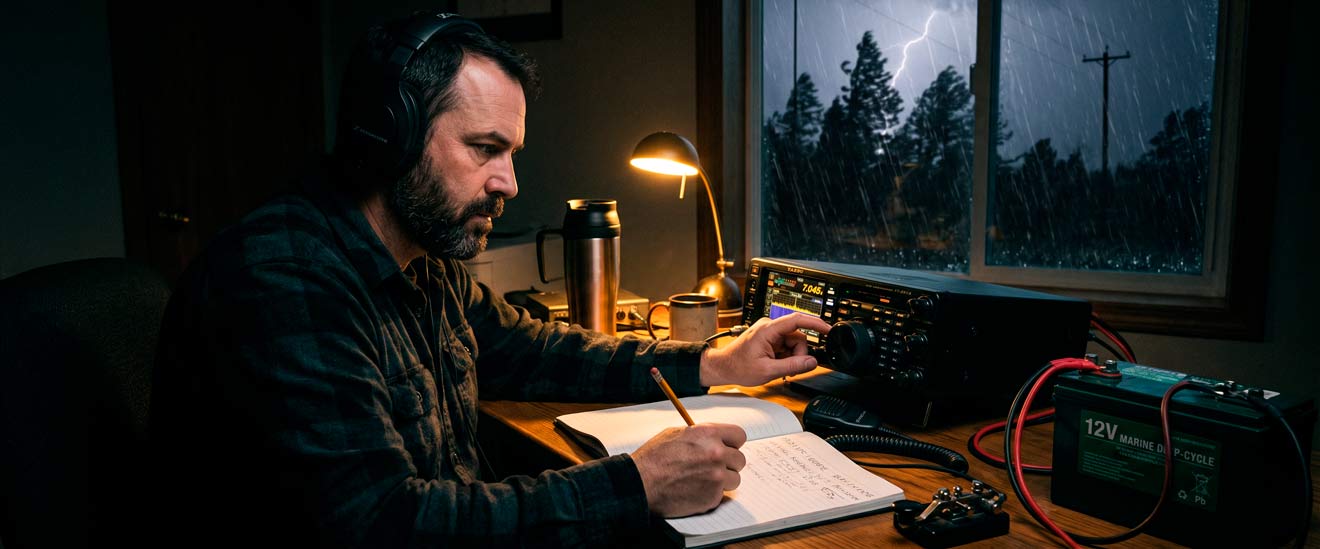
That same night, 200 miles north in a shack outside Atlanta, a volunteer ham operator with a marine battery and a 40-meter dipole was relaying health-and-welfare traffic from Sarasota to the state Emergency Operations Center in Tallahassee. The radio didn’t know the internet was down. It didn’t need to.
Technologies That Work Without Internet
Some things don’t need the cloud. They run on physics, not on a service-level agreement.
Amateur Radio: The Decentralized Network
In Canada, 79,234 licensed amateur operators have access to frequencies from 135 kHz to 250 GHz. That number isn’t an estimate, it’s ISED’s count as of March 2024. When a wildfire near Fort Nelson in May 2024 burned through fibre lines and took down cell towers across the Yukon for nearly 24 hours, ham radio operators were the only link in and out of the territory. Shane Skarnulis at Yukon Emergency Measures Organization confirmed it: no commercial systems worked. HF radio did.
Why? Because ham radio has no central point of failure. Two radios, two antennas, two power sources. That’s it. No cell towers. No routing protocols. No DNS.
And unlike commercial systems, amateur radio operators are legally required to identify themselves. They can’t hide. In an emergency, that matters.
Analog Tools That Ignore the Grid
A magnetic compass points north regardless of what SpaceX is doing. A paper topo map doesn’t need a firmware update. A 1960s-era rotary phone connected to a copper landline draws power from the central office. Sometimes, that line still works when the neighbourhood fibre ONT is dark.
Unexpected fact: In 2023, the Canadian government quietly updated its emergency preparedness guide to recommend a battery-powered AM/FM radio, not a smartphone, not a DAB+ digital receiver. The reason: digital broadcasts require more infrastructure and decoding chips. AM radio travels further and receivers are simple. In a prolonged outage, that matters.
Fully Online Ecosystems
Some systems aren’t just online. They are the connection. Without it, they’re not degraded. They’re gone.
SaaS and the Illusion of Local Control
On June 8, 2021, a single configuration change at Fastly, a content delivery network, took down Amazon, Reddit, the UK Government website, and large portions of CNN. The outage lasted 49 minutes. Global economic impact was estimated at $150 million. Millions of users stared at working computers that couldn’t reach their own data.
Most modern business software is like this. Google Workspace. Microsoft 365. Slack. If you can’t resolve the domain, you can’t work. The data exists, somewhere, but you can’t touch it.
Online Casinos: Dead Air When the Net Drops
Online casinos offer a stark example of pure connectivity reliance.
Unlike a physical slot machine in a Vancouver casino, which contains a certified random number generator chip and will spin and pay out even if the building’s network is down, an online casino game is a video window to a remote server. The spinning wheel on your screen is a rendering. The outcome is calculated elsewhere, logged elsewhere, and audited by a regulator in Malta or Kahnawake.
Here’s what happens when a rural Canadian internet connection drops during an online casino session:
- The video stream freezes mid-action.
- The bet is logged on the local device but not yet confirmed by the server.
- The player’s account balance enters an indeterminate state.
- Reconnection may or may not restore the session correctly.
The online casino server might be running perfectly on generator power in a Toronto data center. It doesn’t matter. The player in Thunder Bay with a downed fibre line is locked out. The platform provides exactly zero utility.
How much revenue do online casinos lose during regional internet outages? The operators don’t publish those numbers. But consider: Ontario’s regulated iGaming market handled $63 billion in wagers in 2023–2024. Even a 0.1% downtime rate translates to significant unrecoverable volume. And that’s just one province.
Detour fact without function: The largest online casino server farms in North America are often located in the same industrial parks as hospital data backup centers. Same generators. Same fibre rings. Same flood risk.
Risks of Digital Dependence
The problem isn’t that cloud services fail. Everything fails. The problem is correlated failure.
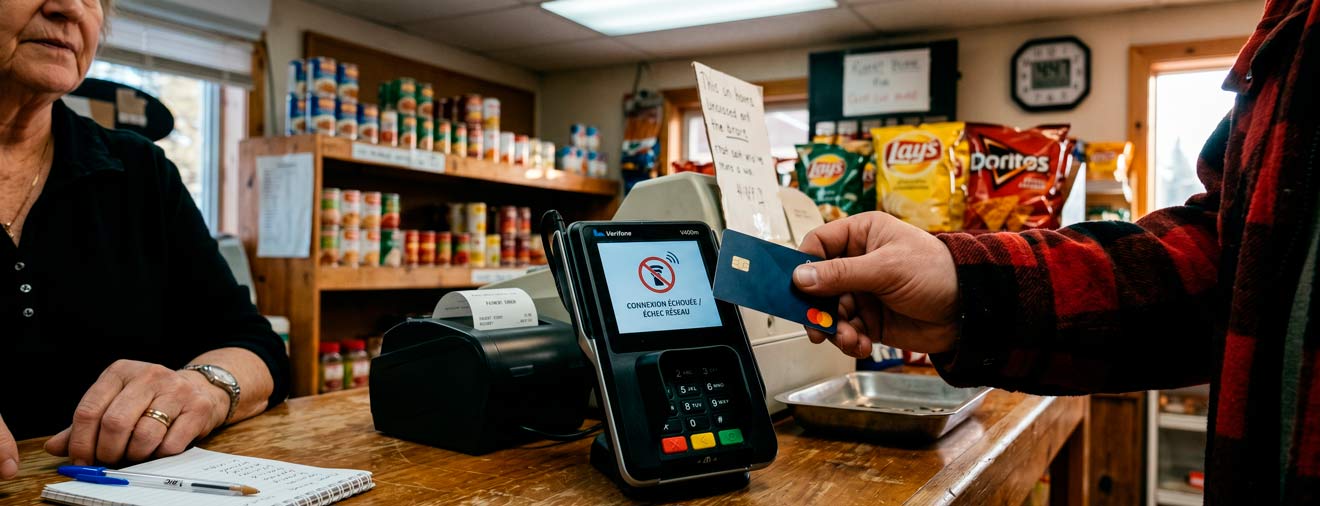
When a fibre optic cable is cut, it doesn’t just take down Netflix. It takes down 911. It takes down payment terminals. It takes down remote health monitoring. It takes down online casino access, sure, but also the ability to check if a loved one in another town is okay.
July 14, 2023. A construction crew near Temiskaming Shores, Ontario, severed a major fibre trunk. For 11 hours, roughly 30,000 people in five communities had no internet, no cellular data, and no long-distance calling. Interac debit machines showed “Connection Lost.” Gas stations couldn’t process cards. One hospital had to revert to paper triage and runner-based communication between departments.
The backup radio system worked. It was amateur radio operators who relayed messages between the hospital and the emergency operations center in North Bay. 11 hours. 30,000 people. One cut cable.
And here’s the part nobody talks about: power. Your fibre ONT needs electricity. Your Wi-Fi router needs electricity. Your cell tower has battery backup, usually 4 to 8 hours. After that, it’s silent. A handheld ham radio runs on AA batteries.
Hybrid Models and the Future
The answer isn’t to abandon the internet. That’s not realistic. The answer is to design systems that degrade gracefully.
- Edge computing is one approach. Applications that store data locally and sync when possible. If the connection drops, you still have your documents, your maps, your reference materials. Apple Notes does this. So does Obsidian. Google Docs doesn’t.
- Satellite redundancy adds a layer. Starlink and other LEO constellations bypass local fibre cuts. But they still depend on ground stations, power, and clear sky. During the 2024 Yukon outage, some Starlink terminals worked, but only those with backup power and no smoke interference from the wildfires.
- Amateur radio digital bridges offer something else entirely. Winlink allows an operator to compose an email offline, then transmit it via HF radio to a gateway station hundreds of miles away. That gateway, assuming it has internet, delivers the message to the global email system. It’s asynchronous. It’s slow. But it works when nothing else does.
A firefighter in a remote BC valley with no cell service can send a Winlink message to an online casino customer support email address if that’s the only contact method for a family member. It sounds absurd. It’s real.
The hybrid model isn’t about choosing between offline and online. It’s about having a path between them when the main road is closed.
In February 2025, the CRTC released a report on the July 2023 Ontario outage. Recommendation 14: “Consider amateur radio as a complementary emergency communications layer in municipal emergency plans.”
79,234 Canadian license holders. A network that costs nothing to use and works when everything else doesn’t. The technology is a century old. The need for it is not declining. Wildfires are increasing. Floods are increasing. Fibre cuts are increasing.
When the grid goes down, the spinning wheels of an online casino freeze. The radio static clears. And someone, somewhere, keys the mic and asks if anyone’s out there.
Someone always is.